

Relocating to Rockledge From Out of State: A Step-by-Step Timeline
If you're relocating to Rockledge from out of state, the hardest part usually isn't deciding you want to move here — it's figuring out what order things actually need to happen in. I've walked enough out-of-state buyers through this that I can tell you the moves that go smoothly and the moves that don't usually come down to the same thing: sequencing. People who work backward from their closing date, instead of forward from "I found a house," end up far less stressed. So here's the real timeline, the way I'd walk you through it if we were sitting across from each other.
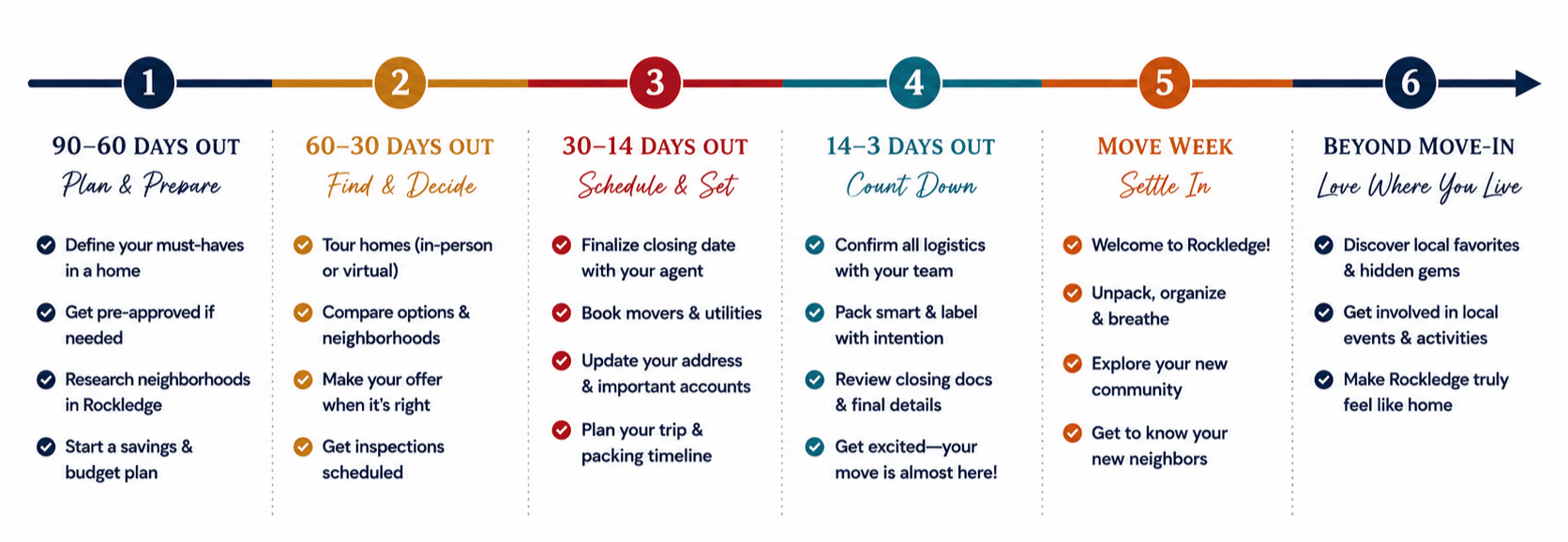
90 to 60 Days Out: Get Your Financial Picture Straight First
Before you fall in love with anything on Zillow, get pre-approved with a lender who actually understands Florida — specifically Brevard County. This matters more here than in a lot of markets, because your lender needs to be fluent in flood zones, insurance timelines, and the way Florida closings work with title companies rather than attorneys in most cases. A lender who's never closed a loan east of the Mississippi is going to slow you down later, right when you can least afford it.
This is also the window to start an honest conversation about insurance. I say this to every relocating buyer, and I'll say it to you too: homeowners insurance and flood insurance are a real line item here, not an afterthought, and the number depends heavily on the specific property — elevation, roof age, distance from water. Rockledge sits on the western bank of the Indian River, and while most of the city is well removed from flood zone complications, some pockets near the river do carry that consideration. Better to know that in month three than discover it during underwriting in month one.
60 to 30 Days Out: The House Hunt, Done With Eyes Open
This is where a lot of relocating buyers make their first real decision, often without realizing it's a decision: old Rockledge or Viera. Old Rockledge — the neighborhoods along the historic Banana Road corridor, under a canopy of mature oaks, with homes that have genuine character and history — is one of the oldest incorporated cities in Florida, and it feels like it in the best way. Viera, the master-planned community adjacent to Rockledge, is the more polished, newer-construction option, with a Town Center, golf, and the kind of amenity-driven layout a lot of relocating buyers recognize from other states. Neither is "better." They're different answers to different questions. If you want character and an established neighborhood feel, you're looking at old Rockledge. If you want new construction and a planned community, you're looking at Viera.
This is also when I'd encourage you to think about commute, because Brevard is a long, narrow county, and how you get around matters more than it might in a more compact metro. Rockledge sits right off I-95 and US 1, which makes it a genuinely practical commuter choice — for L3Harris employees working the Melbourne-to-Rockledge aerospace corridor, for anyone commuting toward Kennedy Space Center, or for households splitting commutes in two different directions. If you're relocating for a job at L3Harris, Health First, or anywhere in the aerospace and defense sector, ask about the specific commute from any home you're seriously considering — not the general "it's close" answer, the actual drive at 7:45 on a Tuesday.
If you've got kids, this is also your school research window. The Rockledge and Viera corridor consistently has strong elementary and middle school reputations, and Viera High School is newer and well-resourced. I always tell relocating families the same thing, though: verify current school assignments directly with Brevard Public Schools before you buy, since boundary lines shift, and I'd rather you have the real answer than a real estate agent's confident guess.
30 to 14 Days Out: Contract to Close, and the Logistics Nobody Warns You About
Once you're under contract, Florida closings move on their own rhythm — title work, inspections, and appraisal typically running in parallel rather than in sequence, which surprises buyers coming from states where things happen more linearly. This is the stretch where I'd start locking in the unglamorous logistics: booking your moving company (get Florida-experienced movers if you can — they understand things like humidity-sensitive furniture and hurricane-season scheduling in a way an out-of-state mover sometimes doesn't), scheduling your utility transfers, and starting your address-change list in earnest.
For utilities specifically, expect to be dealing with a city or county water provider depending on exact address, Florida Power & Light for electric, and your choice of internet provider — none of which can typically be set up more than about two to three weeks ahead of your move-in date, so don't try to get ahead of yourself here. It'll just mean re-confirming everything closer to the date anyway.
Moving Week: What Actually Matters
Moving week in Florida has one variable a lot of out-of-state movers underestimate: the heat, even outside of peak summer. Schedule your movers for morning hours if you have any flexibility, keep water on hand for everyone involved, and don't be surprised if things simply move a little slower in the Florida humidity than they did in your last move. It's not a big deal — it's just a different rhythm, and knowing that ahead of time keeps it from feeling like something's going wrong.
Your First 30 Days: Making It Official
Florida gives you a defined window to get legal, and it's worth doing promptly rather than letting it drift. Generally, that means registering to vote, transferring your driver's license, and registering any vehicles within 30 days of establishing residency. It also means filing for your homestead exemption — in Florida, this isn't optional paperwork you can skip; it directly affects your property tax bill for years to come, and the filing window has a hard deadline tied to the calendar year, so this is genuinely worth putting on your calendar the week you close, not the week you get around to it.
This is also, honestly, the best 30 days to just be a resident instead of a house-hunter. Drive the Banana Road corridor at golden hour. Find your nearest Indian River Lagoon access point. If there's a launch scheduled, go watch it from somewhere public — you'll understand within about ninety seconds why people who live here plan evenings around it instead of treating it as a novelty.
A Few Questions I Get Asked All the Time
Do I need to worry about hurricanes when relocating to Rockledge? It's a real, honest conversation, not a scare tactic — hurricane season runs June through November, peaking August through October. Rockledge, being on the mainland side of the county rather than the barrier island, generally fares better than beachfront communities, but every Florida homeowner should have a plan, not just insurance.
Is Rockledge or Merritt Island the better fit for someone relocating? They're genuinely different. Merritt Island is water-adjacent nearly everywhere and unincorporated, meaning no city taxes. Rockledge has more of a classic, tree-lined small-city feel with strong commuter access. It usually comes down to whether water proximity or historic neighborhood character matters more to you.
How far in advance should I start this process? Ninety days is comfortable for most relocating buyers. It's doable in 60 if your financing is already in order, but I wouldn't recommend compressing it much further than that if you can avoid it.
If you're working through this timeline right now and want to talk through where you actually are in it, that's exactly the kind of conversation I'm happy to have — no pressure, just a clear next step.
— Vanessa | HomeSmart Coastal Realty | Your Space Coast Area Specialist